
Finance Minister Nirmala Sitharaman on Thursday said the country needs big and world-class banks, and discussions are on with the Reserve Bank and lenders in this regard.

The Indian economy is growing at a robust pace, driven by strong domestic demand, low inflation, and the healthy balance sheets of banks, said a Reserve Bank report released on Wednesday.

The Nifty 50 firms' contribution to the overall earnings of India Inc has steadily declined, reaching its lowest share in at least 21 quarters at 47.1 per cent in Q4FY26, down from 51.8 per cent a year earlier.

India's Central government is likely to see its fertiliser subsidy bill double to a record 3.4 trillion in FY27, up from the Budget estimate of 1.7 trillion, due to surging global fertiliser prices exacerbated by the West Asia war. This significant increase, coupled with revenue losses from excise duty cuts for oil-marketing companies, is straining the government's fiscal space, though capital expenditure plans remain unchanged.

'In the last one year, we have added more than Rs 1.7 trillion, and we are on track.'

Batting for further consolidation in public sector banking, the executives of top public sector banks (PSBs) said there should be at least two Indian banking entities among the top 20 global banks.

'Credit growth in India remains in double digits, even though corporate borrowing is subdued.' 'Corporate credit is weak because companies are cash-rich and cautious amid global uncertainty.'

Bank of Baroda economists project India's GDP to grow 6.5-6.8 per cent in FY27 but warn that the fiscal deficit could overshoot the budgeted 4.3 per cent target, potentially reaching 4.7-4.8 per cent of GDP due to subsidy overruns, excise duty cuts, and oil marketing company losses.

Larger NGOs could no longer work with smaller ones, especially those organisations working on the ground that had no means of or expertise in raising money themselves, reveals Aakar Patel.

While opening new accounts, banks can check if the name appears in any mule data. In case it does, the bank can conduct enhanced due diligence.

The Reserve Bank of India (RBI), in its Financial Stability Report (FSR), cautioned that stress tests indicate two scheduled commercial banks (SCBs) may have to dip into their capital conservation buffers (CCBs), unless stakeholders infuse capital, under a scenario involving a gradual slowdown in domestic GDP growth and a moderate rise in inflation, with limited policy easing space available to the central bank.

Dell Technologies is significantly expanding its domestic manufacturing in India, with a majority of its servers now produced locally, driven by data sovereignty and AI adoption. The company also launched new AI infrastructure solutions, including PowerStore Elite, designed for secure on-premises data management and AI workflows, while asserting that AI creates more jobs.

Despite geopolitical tensions and FII outflows, Indian small and midcap stocks have not only recovered losses but are also outperforming largecap indices, driven by attractive valuations, domestic institutional support, and a rebound in earnings.

India's mutual fund industry has significantly increased its share of public trading in the stock market, widening its lead over the Life Insurance Corporation of India (LIC) for the fifth consecutive year. While LIC's share of free-float listed shares has fallen to 7.42% as of March 2026, the mutual fund industry's share has surged to 22.92% from 7.06% in 2012.

State Bank of India Chairman C S Setty has expressed support for a 'pause' in policy rates by the Reserve Bank of India's monetary policy committee, believing it will help stabilise conditions and support economic growth. He also urged investors to look beyond short-term equity market movements and focus on India's structural transformation, driven by reforms and digital infrastructure.
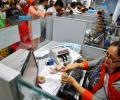
State Bank of India-led public sector banks posted a record cumulative profit of Rs 49,456 crore in the second quarter of the current fiscal, reflecting a 9 per cent year-on-year growth despite two lenders reporting a decline. All 12 public sector banks (PSBs) together made a profit of Rs 45,547 crore in the September quarter of FY25.

Investors should do thorough due diligence when selecting a platform.

'India is often skipping legacy cycles and moving directly to advanced AI-driven operations.'

Private sector banks slipped in market capitalisation (mcap) during the July-September quarter, underperforming their government-owned peers as trade uncertainties dragged market sentiment, said S&P Global Market Intelligence. According to its analysis, HDFC Bank shed 4.8 per cent in mcap during the third quarter, while ICICI Bank's dropped 6.7 per cent.

Ahead of the Reserve Bank of India's (RBI's) monetary policy review in the first week of December, major public sector non-banking financial companies (NBFCs) - the National Bank for Agriculture and Rural Development (Nabard), Small Industries Development Bank of India (Sidbi), Power Finance Corporation (PFC), and Indian Railway Finance Corporation (IRFC) - plan to raise up to Rs 24,000 crore together through bond issuancesk.

Indian benchmark equity indices, Sensex and Nifty, ended lower after a five-day rally, with the Sensex dropping 607 points and the Nifty falling to 24,013.10. The decline was primarily driven by heavy selling in IT firms following Accenture's trimmed revenue guidance and renewed geopolitical uncertainty, specifically the postponement of US-Iran negotiations.

But selectively, with regulatory scrutiny and special approval, points out Tamal Bandyopadhyay.

The Indian stock market mythos of 36 years is wrapped in a diaphanous negligee, lashed together by a delicate, etheric sash of 1.6 bull markets. To make money from here on will require a ground invasion, trench by trench, rather than carpet bombing. Way more difficult, points out Shankar Sharma.

The Reserve Bank of India (RBI) has issued a statement assuring the public of HDFC Bank's stability and sound financial position following the resignation of its chairman, Atanu Chakraborty, citing ethical concerns.
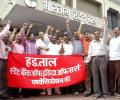
Bank employees want a five day work week.

Global oil prices fell on Thursday to their lowest levels since before the outbreak of the Iran conflict, offering a significant economic tailwind for India, the world's third-largest crude importer, by easing inflation risks, reducing the import bill and improving the government's fiscal position.

Hyderabad Police Commissioner V C Sajjanar convened a meeting with bankers to address the misuse of bank accounts in cyber frauds and implement preventative measures, following 'Operation Octopus' which dismantled cyber fraud networks and led to arrests of complicit bank officials.
The IBPS clerk application form for 2025 will be released on July 31. The IBPS Clerk preliminary exam 2025 is scheduled to be held on October 4, 5 and 11.

The Confederation of Indian Industry (CII) has proposed a 20-point policy agenda to the finance ministry, including a conflict-linked emergency credit line guarantee scheme and tax rationalisation on energy inputs, to support MSMEs, exporters, and energy-intensive industries affected by the ongoing West Asia war.

West Asia conflict triggers sharp sell-off in Indian markets, with realty, banking and auto stocks leading losses amid energy shock fears.

Following through announcements with enforcement of measures is key, as a run through recent Indian economic history shows, points out A K Bhattacharya.

State-owned banks are prioritising local language skills in their hiring to improve customer service and reduce language barriers.

Noting that recent uncertainties created by global tariffs have not impacted the Indian economy severely, Anuradha Thakur, secretary, Department of Economic Affairs, said the central government is hopeful that the recent goods and services tax (GST) rationalisation will ignite the much needed animal spirits in the financial sector.

India emerged reasonably well from 2025. But now, the oil shock and war-related supply disruptions have again driven funds out of India and significantly weakened the rupee, points out Ajay Chhibber.
The United Forum of Bank Unions (UFBU) on Thursday said its two-day nationwide strike on March 24 and 25 will be observed as scheduled since discussions with the Indian Banks' Association (IBA) over key demands failed to yield any positive outcome. In a meeting with the IBA, all UFBU constituents raised issues, including recruitment in all cadres and a five-day workweek.
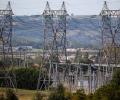
The government on Wednesday put out the draft of a new policy that projects the country's power sector will need Rs 50 trillion in investments by 2032 and Rs 200 trillion by 2047, proposing ambitious reforms in generation, transmission and distribution.

Companies listed on the National Stock Exchange (NSE) main board increased their Corporate Social Responsibility (CSR) expenditure by 23 per cent year-on-year to Rs 22,212 crore in 2024-25 (FY25), driven by a significant jump in average net profits, according to a PRIME Database Group report.

Reliance Industries Ltd reported a 12.5 per cent fall in its March quarter net profit, primarily impacted by the global energy crisis affecting its oil and chemicals business, while its consumer-facing Jio Platforms unit saw a 13 per cent increase in profit after tax.

Ashok Lahiri, a distinguished economist with experience in government, the private sector, and electoral politics, has been appointed as the new Vice-Chairman of NITI Aayog, tasked with strengthening India's reform trajectory and policy-making.

Through anchor allotment, a firm can demonstrate the demand for shares by getting marquee investors on board.
